
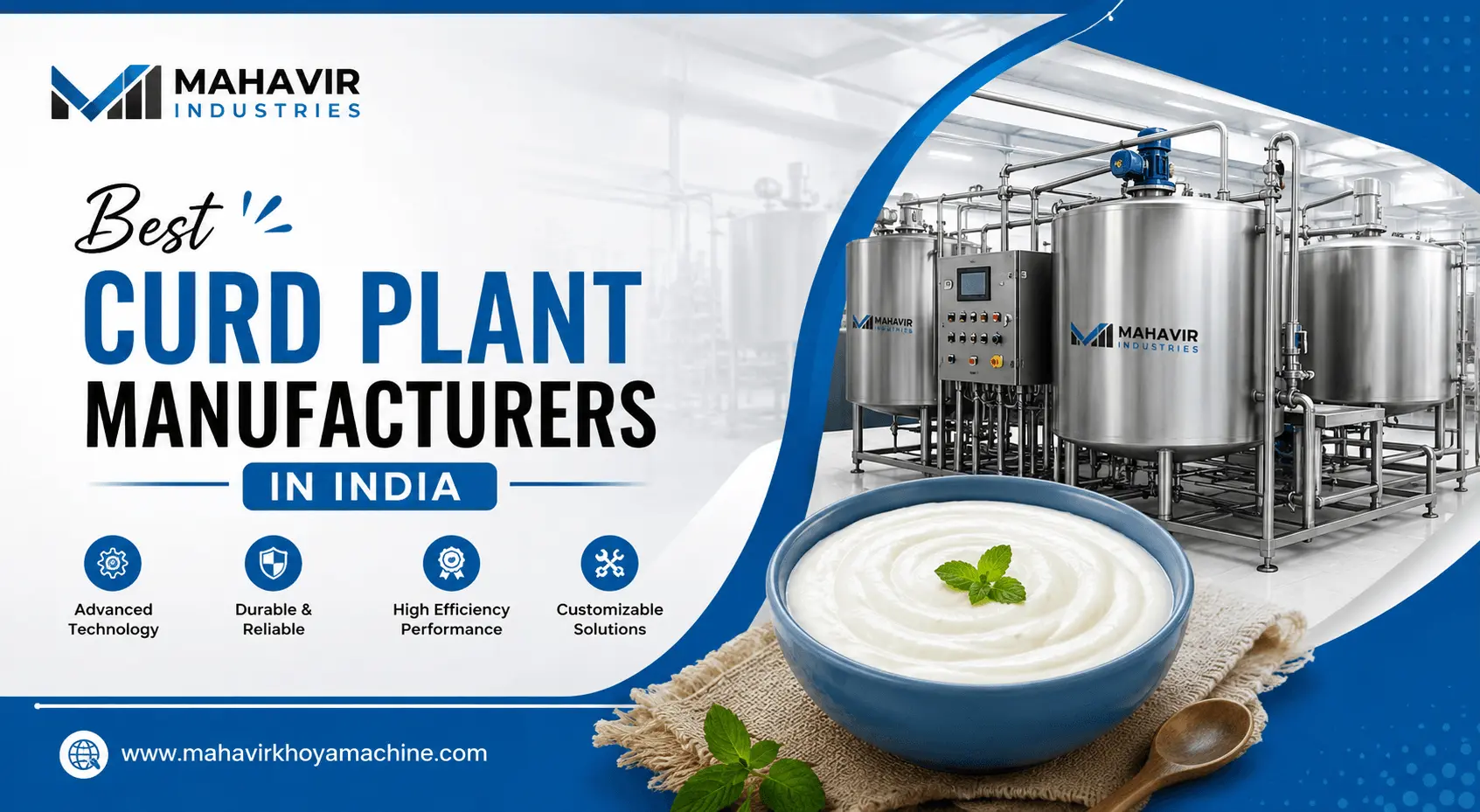
A rapidly growing market that nobody is talking about is packaged curd. In the recent market studies, the size of the packaged curd market is projected to grow at a massive CAGR of 12.52% by 2033. For dairy businesses that are not into curd manufacturing, it is a serious disadvantage. But setting up the machinery for factory curd production is not a great challenge if you are already into dairy production or planning to establish it. Partnering with the curd plant manufacturers for the right machines is what you should be looking at.
Why Invest In Modern Curd Production Unit
With the growing urban and semi-urban population, consumers are demanding more packaged curd over homemade curd. It promises consistency in quality and quantity. Unlike seasonal items, the demand for curd is continuous throughout the year. It is an encouragement for the businesses that want to generate stable revenue through curd production.
Here’s why you should invest in the modern curd plant:
- Modern machines for curd making have a higher speed and precision, which means the output is consistent.
- The customers repeatedly get the same quality that they expect.
- Packaged curd is perceived as a cleaner and more hygienic option.
- By installing a higher-capacity machine, you can increase your production without compromising on quality.
- Uniform fermentation creates a better texture and taste of dahi.
Automated process reduces manual effort and improves output.
Step-by-Step Curd Manufacturing Process
Fermentation is the key step that defines the quality of curd. But there are streamlined before and after fermentation steps. These are:
Filtration of Raw Milk: Milk sourced from the farms and collection centres is filtered.
Cooling for Storage: Bulk milk coolers rapidly cool the milk to prevent the growth of bacteria that spoil or alter the quality of milk.
Standardization: Cream is separated to standardize the amount of fat present in the milk.
Pasteurization: Milk is now steam heated at a low temperature to kill the bacteria. Until this stage, most milk plant processes are same.
Lactic Acid Bacteria Addition: This is the stage where curd production begins. The starter culture containing bacteria with lactic acid is added to the batch of milk.
Incubation: In an incubated setting, milk is fermented for curd to set.Cooling to Stop Fermentation: After curd is developed in the batch, it is cooled to stop the process and packaging begins.
Qualities of High-Performance Curd Plant
A strong unit is built by choosing the right from the best curd plant manufacturers. Here are the qualities you need to look for:
Better Control on Processing
With the digital controls and design advancements, the process of fermentation and other steps is carried out with better control over quality.
High Production Rate
As the machines are regularly inspected and operations are supervised by experts, the production rate is high. Minimal material wastage is also a key reason behind it.
Hygienic Handling
The use of food-grade stainless steel material for the surfaces in contact with milk is responsible for hygienic processing. It prevents contamination by unwanted microbes and dirty particles.
Precise Temperature Management
Temperature variation affects the quality of milk, so the bulk milk coolers keep it under precise control before and after fermentation.
Conclusion
Establishing a curd processing plant requires an understanding of dairy processes, machinery and operations. You would need to maintain consistent quality, which your customers expect from your output. The pasteurizer, fermentation chamber, and other equipment must be purchased from the trusted curd plant manufacturers. We recommend you choose Mahavir Industries, where you get all the equipment in your preferred capacity.